

Some called it crazy — others, inspired. Two years to the month after a killer whale named Tilikum, captured off Iceland, killed trainer Dawn Brancheau at SeaWorld Orlando on February 24, 2010, igniting a heated public debate about whether killer whales belong in captivity, People for the Ethical Treatment of Animals (PETA) asked a judge to let it sue SeaWorld on behalf of Tilikum and the four other captured killer whales in SeaWorld’s collection.
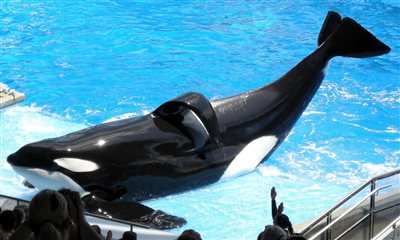
The thrust of the suit: These five captured orcas — Tilikum and Katina in Orlando; Corky, Kasatka and Ulises in San Diego — were all taken away from their families, society and natural environment and thrown into captivity in violation of Thirteenth Amendment protections against slavery and involuntary servitude.
These protections were drafted to protect humans, but some progressive thinkers believe they should also be extended to killer whales and other big-brained, intelligent, self-aware, socially sophisticated marine mammals. So PETA decided to take the argument to court.
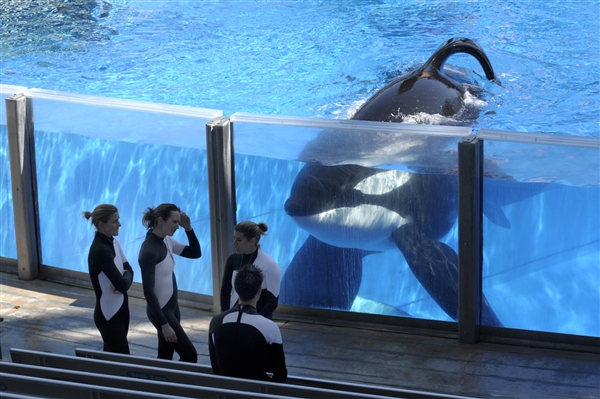
SeaWorld called the suit, filed in October, a stupid publicity stunt and asked San Diego Federal District Court Judge Jeffrey Miller to dismiss it immediately at a February 6 hearing. Dolphins and whales have rights? Please. But Judge Miller didn’t dismiss it. He let both sides present their arguments about why the case should or shouldn’t proceed and said he’d rule later.
That gave SeaWorld reason to sweat a bit and marine-mammal advocates reason to hope. As PETA attorney Jeffrey Kerr said afterward, Judge Miller had set a legal precedent by even letting PETA argue that the suit should be allowed to go forward. Would he go farther and actually let it proceed?
No. Two days later, on February 8, 2012, Judge Miller sided with SeaWorld and tossed out the suit, writing in part that “there is simply no basis to construe the Thirteenth Amendment as applying to nonhumans.”
Not yet, anyway. But as Kerr said later, the defeat doesn’t change the fact that these five captured killer whales (and another named Lolita at the Miami Seaquarium) who “once lived naturally wild and free are today kept as slaves….” Kerr couldn’t say what PETA’s next move would be, but he did say there will be one. So the round goes to SeaWorld, and the fight goes on.
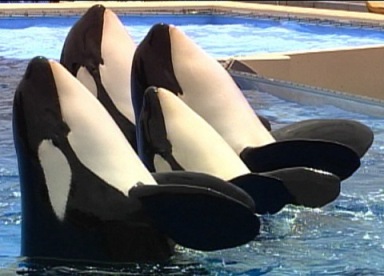
That makes one ruling in SeaWorld’s favor and one to go.
For those tuning in late: After Tilikum killed Dawn Brancheau at SeaWorld Orlando, the Occupational Safety and Health Administration (OSHA) sent inspectors to investigate whether killer-whale-trainer working conditions in Orlando had contributed to her death.
The agency decided that, yes, working conditions were a factor and ended up citing and fining SeaWorld for “willful disregard” for trainer safety: that is, for knowingly putting trainers at risk by letting them get close to and in the water with orcas without adequate mechanisms in place to protect them from harm.
Until SeaWorld corrected this situation, OSHA concluded, trainers should be kept out of the water and away from killer whales even at poolside. SeaWorld squawked, not surprisingly, and requested a hearing to challenge OSHA’s findings and fines.
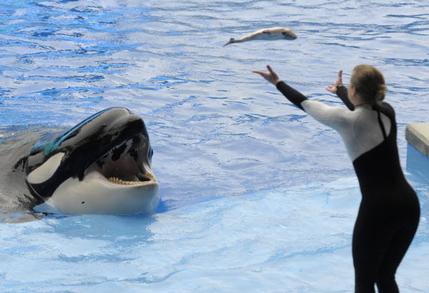
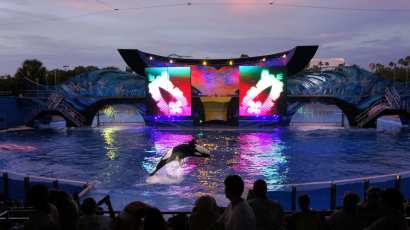
When GNN last reported on SeaWorld in April 2011, the Orlando park had just premiered the new “One Ocean” show that SeaWorld had rushed into production to replace the long-running “Believe” show it had had to scrap once trainers could no longer get in the water with killer whales. (“Believe” was built around these in-water interactions, called “water work.”)
SeaWorld Orlando had also managed to postpone the start of its courtroom tangle with OSHA from April 2011 to later in the year. (April is Spring Break season, which is followed by Summer Family Vacation season, and SeaWorld Orlando didn’t need the local media rehashing the ugly particulars of Dawn Brancheau’s death during that high-tourism time of year.)

The hearing finally got underway in Sanford, Florida, in September 2011, and, after another delay, wrapped up in November.
Presiding Administrative Law Judge Ken S. Welsch has yet to decide whether he’ll let OSHA’s fines and findings stand (and put a major crimp in SeaWorld’s stated desire to get trainers back in the water with orcas asap) or dismiss these findings and let SeaWorld get back to business as usual for a while longer at least…
…Until another tragedy puts the spotlight back on SeaWorld, that is, and/or the marine-park-visiting-public becomes more educated about who dolphins and whales really are and how they’re meant to live versus what SeaWorld and other marine parks do with and to them in captivity.


A number of writers and reporters — the Orlando Sentinel’s Jason Garcia, Seattle PI blogger Candace Calloway Whiting, and blogger and Outside Magazine correspondent Tim Zimmermann chief among them — have been doing their part to raise awareness by reporting on the many aspects of SeaWorld’s operations that SeaWorld prefers to keep out of the news.
Here, drawing from their reporting and other sources, GNN presents an update on SeaWorld’s activities since April 2011. Two notes:
1. This update begins by backtracking a bit to cover a few pre-April 2011 events that passed unnoted in GNN’S First SeaWorld Report and shouldn’t have. They’re necessary background to events that followed.
2. The timeline is long, with lots of images, because there’s a lot of news.
Scan the whole thing, browse by month, or search by captive marine-mammal species (killer whale, Bottlenose dolphin, beluga whale, pilot whale, Pacific white-sided and a few others) to get a fuller sense of the true reach, scope and nature of SeaWorld’s operations.
It’s been a busy year.
 Gini's Nature News