
Fires rage, volcanoes erupt, galaxies form, asteroids collide — and our satellites and space telescopes capture it all.
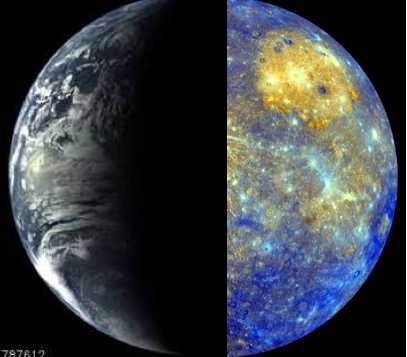
Messenger Spacecraft images of earth from 40,761 miles away (left), Aug 2, 2005, and Mercury from 8,000 miles away (right), Jan 14, 2008/ NASA, Johns Hopkins University Applied Physics Laboratory, Arizona State University, Carnegie Institution of Washington, messenger.jhuapl.edu
Have you seen what the Arizona wildfires, Chile’s volcanic eruption and the flooding Mississippi and Missouri Rivers look like from space? Have you seen the new close-up images of asteroids colliding, the sun flaring and comets whizzing by?
If not, prepare to be wowwed by this sampling of images of terrestrial and celestial events that our increasingly sophisticated satellites and space telescopes are now able to capture. They’re sorted here into two sections — Looking Down (Images of Earth) and Looking Up (Planets & Stars) — with a very special short video under “Best for Last.” If you do nothing else, watch this last video. It’s breathtaking.
Looking Down (Images of Earth)
Fire
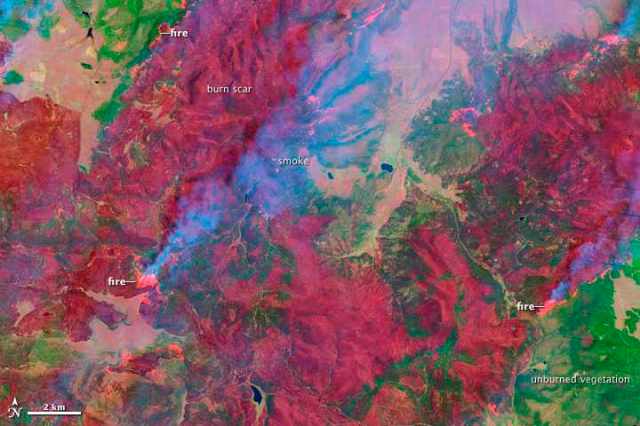
Landsat 7 Satellite image of Arizona Wallow Fire, June 7, 2011/USGS, NASA Earth Observatory, earthobservatory.nasa.gov

Smoke from the Wallow Wildfire surrounds trees in Eagar, AZ, June 7, 2011/Joshua Lott, Reuters, reuters.com
As of Tuesday, June 14, Arizona’s Wallow Fire, now believed to have spread from an unattended campfire, had consumed more than 469,000 acres of land, according to a New York Times report. That’s 1,000 acres more than Arizona’s 2002 Rodeo-Chediski wildfire, previously the state’s biggest — and this one’s still burning.
• To see videos and photographs taken on earth, click here (Russia Today), here (CNN), here (Reuters), here (National Geographic) and here (Huffington Post).
• To see more satellite images of Arizona’s wildfire and other blazes, click here or click the image below.
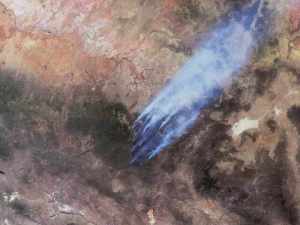
Terra Satellite image of Arizona’s Wallow and Horseshoe 2 Fires, June 7, 2011/ NASA JPL, nasa.gov
Flood
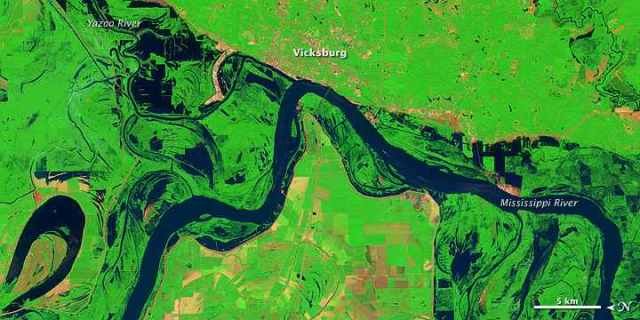
Landsat 5 Satellite image of lingering floodwaters near Vicksburg, MS, June 11, 2011/USGS, NASA Earth Observatory, earthobservatory.nasa.gov

Vicksburg homeowners fight the flooding Mississippi, May, 19, 2011/Reuters, Daily Mail, MailOnline.co.uk
As of June 14, the Mississippi River was still above flood stage and threatening to flood again, and the Missouri River had reached a record 29.6 feet near Williston, ND and had broken through two levees near Hamburg, IA.
• To see more photos and videos taken on earth, click here (Daily Mail), here (Billings Gazette) and here (USA Today).
• To view more satellite images of the Mississippi and Missouri floods and other swollen rivers and flood zones, click here or click the image below.

Landsat 5 Satellite image of Missouri River flooding along South Dakota –Nebraska border, June 5, 2011/USGS, NASA Earth Observatory, earthobservatory.nasa.gov
Volcanoes

Terra Satellite image of ash field and streaming ash cloud from Chile’s Puyehue-Cordon Caulle volcanic eruption, June 13, 2011/NASA Earth Observatory, earthobservatory.nasa.gov

Ash billows from Puyehue-Cordon Caulle volcanic eruption in southern Chile, June 5, 2011/Claudio Santana, AFP, Getty, The Denver Post, denverpost.com
First Nicaragua’s Telica volcano belched ash and gas on May 19, 2011 after slumbering for 60 years. Then Iceland’s Grimsvotn volcano erupted on May 22. Then Mexico’s Popocatepetl (Popo), near Mexico City, erupted on June 3. Then, on June 4, a fissure in southern Chile’s Puyehue-Cordon Caulle volcanic range began pumping enough ash high into the atmosphere to disrupt air travel from Argentina and Uruguay on the other side of the continent, all the way east across the southern Atlantic to Australia and New Zealand.
• To see photos and videos of all four eruptions taken on earth, with a few space shots thrown in for good measure, click here (The Telegraph), here (The Globe and Mail) and here (amazing Denver Post photo gallery).
• To see more great space shots of volcanoes, click here. To see more satellite images of Puyehue’s ash cloud, click here or click the image below.

Aqua Satellite image of ash cloud being spewed from fissue in Chile’s Puyehue-Cordón Caulle Volcanic Range, June 7, 2011/NASA Earth Observatory, earthobservatory.nasa.gov
Earth as Art
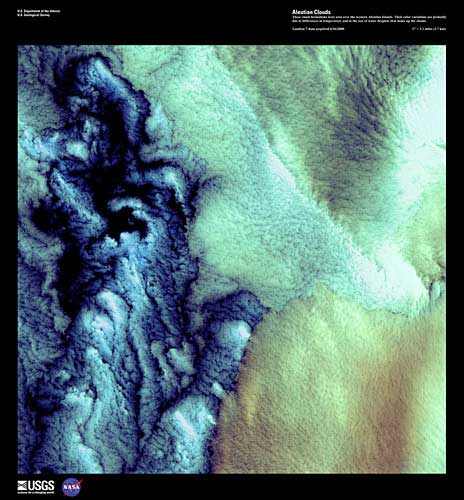
Clouds over the western Aleutian Islands, June 1, 2000/Earth as Art, Landsat 7, USGS, Earth Resources Observation and Science Center (EROS), eros.usgs.gov
Just how unbelievably beautiful is this earth of ours? So beautiful that the good people at the U.S. Geological Survey (USGS) have assembled a gallery of more than 125 exquisite images of various parts of our planet as captured by satellite cameras and have made these images available for viewing and purchase ($25 for a 26″ x 28″ print) so we can all enjoy them.

Edrengiyn Nuruu transition zone between north China deserts (bottom) and Mongolian steppes (top), August 1, 1999/Earth as Art, Landsat 7, USGS, Earth Resources Observation and Science Center (EROS), eros.usgs.gov
Got a wall you’d like to dress up with some exquisite, inexpensive art work? If the images above and below don’t suit, click on any of them or click here to see more.
And thanks to Linda Lee for this Nature News lead.
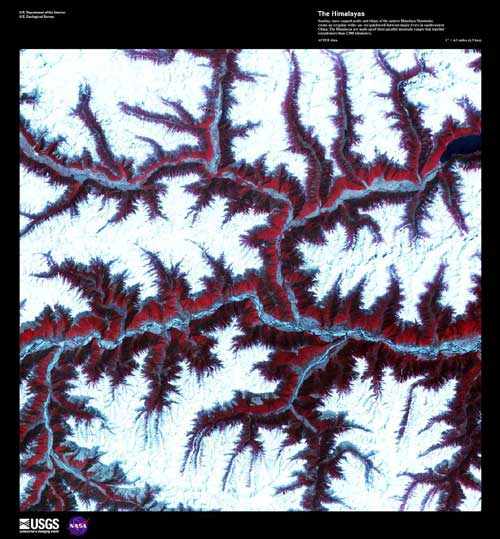
Snow-capped peaks, ridges and rivers of eastern Himalayas in southwestern China, April 12, 2001/Earth as Art 2, ASTER, USGS, Earth Resources Observation and Science Center (EROS), eros.usgs.gov
Yuri’s First Orbit

Image from “First Orbit,” produced by The Attic Room in collaboration with the European Space Agency and NASA/firstorbit.org
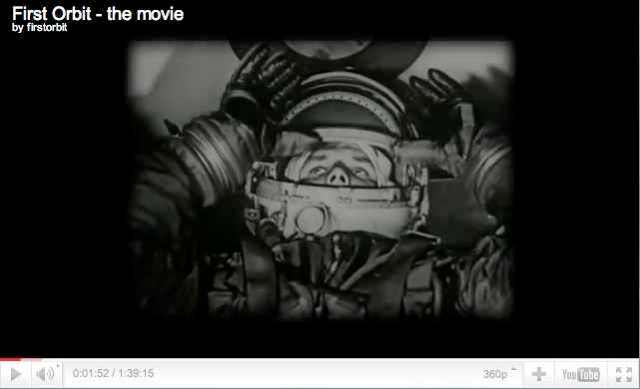
Image from “First Orbit,” produced by The Attic Room in collaboration with the European Space Agency and NASA /firstorbit.org
Images of the earth such as the one above seem almost commonplace now, most people have seen so many. But imagine being the first human being to rocket into space, circle the planet and drink in these vistas firsthand. That person was Yuri Gargarin, who completed the first orbit of Earth on April 12, 1961.
To honor the 50th anniversary of his achievement, a group of filmmakers have produced “First Orbit,” a film recreation of Gargarin’s experience that combines new footage shot by astronauts aboard the International Space Station with actual recordings of Gargarin’s comments during his flight (subtitled in English) and a contemplative musical score that puts viewers in a mood to meditate on what Gargarin might have been thinking during his orbit, sitting inside a cramped capsule, watching Mother Earth slip by below.
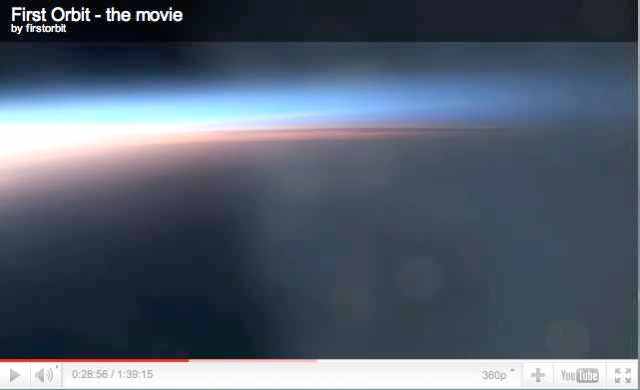
Image from “First Orbit,” produced by The Attic Room in collaboration with the European Space Agency and NASA /firstorbit.org
The film runs one hour and 39 minutes — only nine minutes shorter than Gargarin’s entire flight.
• To learn more about the film and the filmmakers’ next project, click here. To view or download “First Orbit” free of charge, click here or click the images above or below.
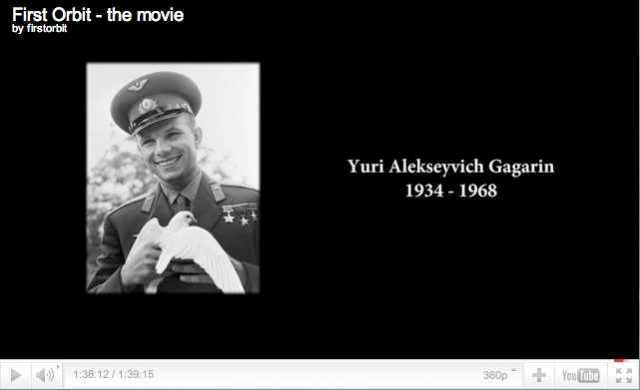
Image from “First Orbit,” produced by The Attic Room in collaboration with the European Space Agency and NASA /firstorbit.org
 Gini's Nature News